
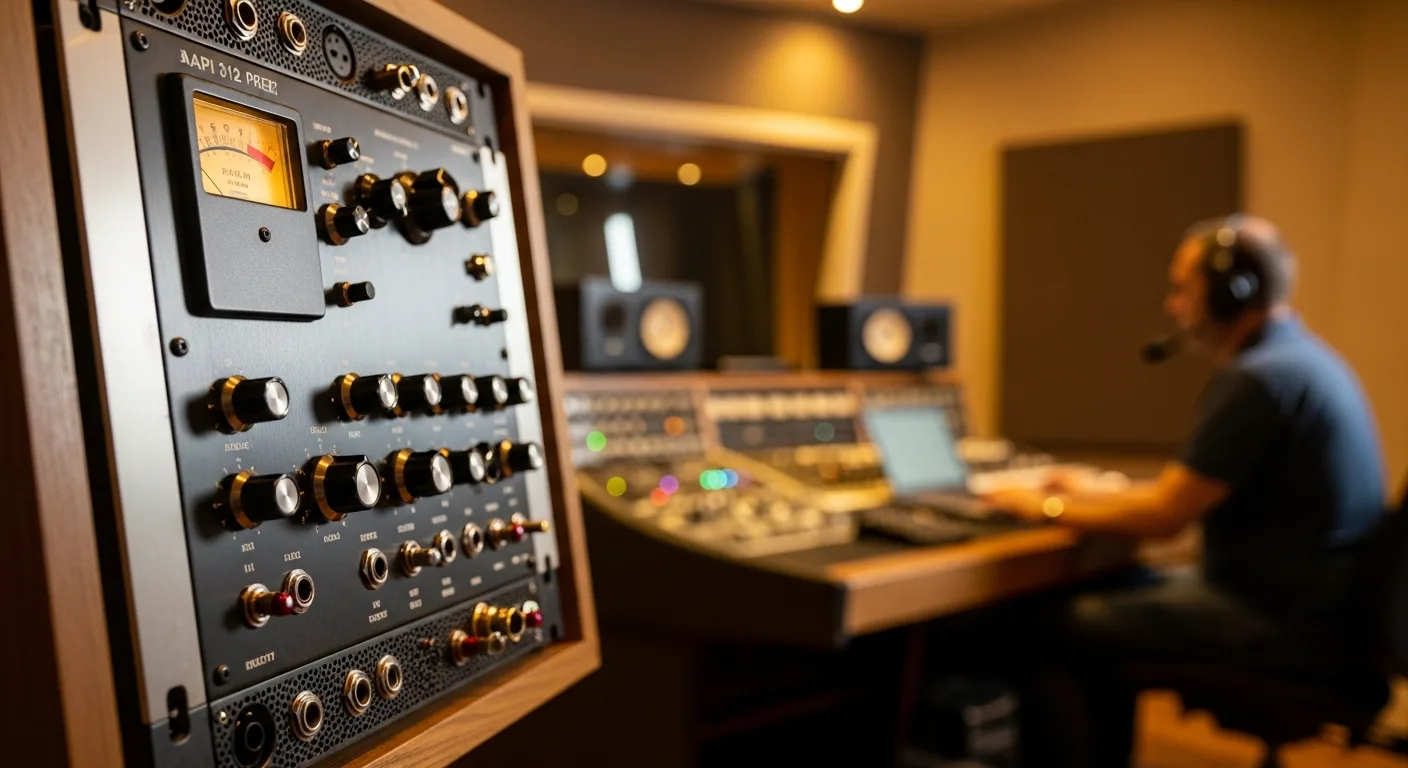
Why is the API 312 Still the Industry Standard for Mic Preamps?
The Timeless Appeal of the API 312 Circuit
In the world of high-end audio engineering, few names command as much respect as the API 312. Originally designed by Saul Walker in the late 1960s, this discrete microphone preamplifier has become the backbone of the American sound. Even as we move through 2026, the demand for its signature punch and clarity has not waned. The 312 is not just a piece of vintage gear; it is a precision instrument that defines how we perceive transients and mid-range presence in modern recordings.
What sets the 312 apart is its simplicity and the high quality of its components. He designed the circuit around the legendary 2520 discrete op-amp and proprietary transformers. This combination allows for massive headroom and a fast response time, making it the first choice for engineers who need to capture the raw energy of a performance without the mushiness often found in lesser designs.
The Core Components: 2520 Op-Amp and Transformers
To understand why the API 312 sounds the way it does, one must look at its internal architecture. The 2520 op-amp is the heart of the unit. Unlike integrated circuits, this discrete component provides the gain necessary while maintaining a low noise floor and high output drive capability. When an engineer pushes the 312, he isn’t just getting volume; he is getting a harmonic saturation that adds weight to the signal.
- AP2516 Input Transformer: This component is responsible for the initial character of the sound, offering a unique impedance matching that favors microphones with high output.
- Discrete Circuitry: By avoiding surface-mount components and integrated chips, the 312 maintains a signal path that is pure and robust.
- Headroom: The 312 can handle high SPL (Sound Pressure Level) sources, such as close-miked snare drums, without clipping in an unmusical way.
It is important to distinguish this hardware component from the software world; while a developer might look for an EDI vs API comparison to understand data protocols, the audio engineer is focused on the voltage and discrete circuitry of the 312 to achieve sonic excellence.
Applications in the Modern Studio Environment
The API 312 is most famous for its performance on percussion and electric guitars. Because of its fast transient response, it captures the ‘snap’ of a drum kit better than almost any other preamp. A recording engineer will often populate his entire drum rack with 312-style preamps to ensure phase coherence and a unified, aggressive sound profile.
On electric guitars, the 312 emphasizes the mid-range frequencies that allow a guitar to cut through a dense mix. When a producer wants a guitar to sound forward and ‘in your face,’ he reaches for the 312. Once the signal is tracked through this high-quality hardware, the engineer often moves to a digital environment, utilizing an audio editing software Mac guide to refine the raw, punchy tracks into a finished masterpiece.
API 312 vs. Modern Reproductions
Today, the 312 is available in several formats, including the popular 500-series modules. While many companies attempt to clone the 312 circuit, the official API versions remain the gold standard. The modern 312 stays true to Saul Walker’s original vision while incorporating modern manufacturing tolerances that ensure consistency across multiple units. For the professional engineer, having a matched pair of 312s is essential for overheads or stereo instrument tracking.
Frequently Asked Questions
What is the difference between the API 312 and the API 512c?
While both share the 2520 op-amp, the 312 is often considered to have a slightly simpler, more direct signal path. The 512c includes additional features like a front-panel XLR input and a LED VU meter, which some purists feel adds unnecessary components to the path, though the sonic difference is often subtle.
Why is the API 312 preferred for drums?
The 312 has an incredibly fast transient response. This means it can capture the immediate ‘peak’ of a drum hit without softening the attack, resulting in a punchier, more energetic drum sound that requires less processing later in the mix.
Can I use the API 312 for vocals?
Yes, he can certainly use it for vocals, especially if he is looking for a ‘rock’ or ‘pop’ sound that is forward and bright. While it may not have the pillowy low-end of a Neve-style preamp, its clarity and mid-range detail make it excellent for helping a vocal sit on top of a busy arrangement.
Who designed the original API 312?
The original circuit was designed by Saul Walker, the founder of API. He is widely regarded as one of the most influential figures in the history of pro audio console design.