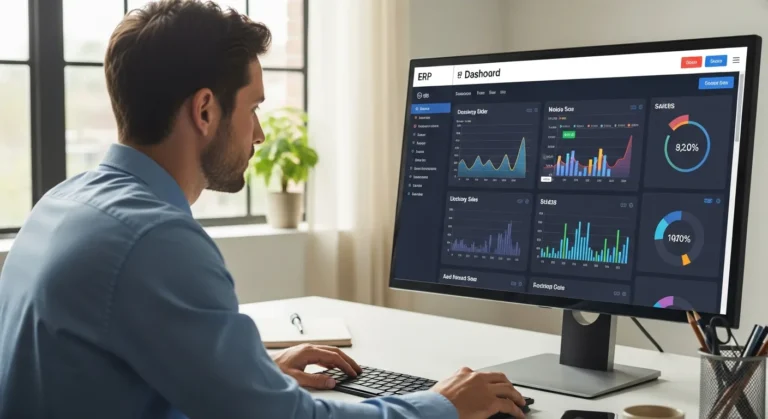

How Fin ERP Systems Redefine Corporate Finance Strategy in 2026?
The Evolution of Fin ERP: Beyond Basic Ledger Management
The role of the Chief Financial Officer has shifted. He is no longer just a gatekeeper of records; he is a strategic architect. In 2026, a Fin ERP (Financial Enterprise Resource Planning) system serves as his primary tool for navigating complex global markets. Unlike legacy systems that merely recorded historical data, modern Fin ERPs provide a forward-looking view of an organization’s health.
These systems integrate disparate financial functions—from payroll and procurement to risk management—into a single, unified interface. This integration ensures that when a manager approves a purchase order in one department, the impact on the overall budget is reflected instantly. For a leader looking to scale, leveraging the latest financial ERP system benefits is the only way to maintain a competitive edge.
Core Modules of a Modern Financial ERP
A robust Fin ERP is built on several foundational modules that work in harmony. Each module is designed to automate specific workflows, reducing the margin for human error and freeing up the finance team for higher-value analysis.
- General Ledger: The central repository for all financial transactions, providing a real-time snapshot of the company’s financial position.
- Accounts Payable & Receivable (AP/AR): Automates invoicing and payment processing, ensuring the business maintains healthy cash flow.
- Asset Management: Tracks the lifecycle of physical and intangible assets, managing depreciation and valuation automatically.
- Treasury and Risk Management: Helps the treasurer manage liquidity and mitigate financial risks related to currency fluctuations or interest rates.
By centralizing these functions, the financial professional ensures his data is consistent across the entire enterprise. This consistency is vital when preparing for audits or presenting to stakeholders.
Fin ERP vs. Standard Accounting Software: Knowing the Difference
Many small business owners often confuse basic accounting tools with a full-scale Fin ERP. While both handle bookkeeping, the scope is vastly different. Accounting software is typically a standalone application that manages the books. In contrast, a Fin ERP is an expansive ecosystem that connects financial data with operational data from sales, HR, and supply chain departments.
Understanding how ERP platforms differ from standard accounting software is essential for any executive planning a long-term technology roadmap. A Fin ERP allows him to perform complex multi-entity consolidations and manage international tax compliance with a few clicks—tasks that would overwhelm a basic accounting package.
The Impact of AI and Predictive Analytics in 2026
In 2026, artificial intelligence is the heartbeat of the Fin ERP. It has moved past simple automation into the realm of predictive intelligence. The system doesn’t just tell the user what happened last month; it predicts what will happen next quarter based on current market trends and internal performance.
For example, a financial analyst can use his ERP to run “what-if” scenarios. If he increases the R&D budget by 15%, the system can simulate the impact on the company’s cash reserves over the next two years. This level of foresight allows him to make bold moves with confidence, backed by hard data rather than gut feeling.
Strategies for a Successful Fin ERP Implementation
Implementing a Fin ERP is a significant undertaking that requires a clear vision. The project lead must ensure his team is aligned with the new processes before the software goes live. A common mistake is trying to force old, inefficient workflows into a new, sophisticated system.
Key steps for a smooth rollout include:
- Data Cleansing: Before migrating, the user must ensure his existing data is accurate and free of duplicates.
- User Training: Every employee who interacts with the system needs to understand his specific role and how his inputs affect the larger financial picture.
- Phased Approach: Rather than a “big bang” launch, many successful firms roll out modules in stages to minimize operational disruption.
When the implementation is handled correctly, the business gains a scalable foundation that grows alongside its ambitions.
Frequently Asked Questions
What is the primary purpose of a Fin ERP?
The primary purpose is to centralize all financial data and processes into one system, providing real-time visibility, improving accuracy, and enabling better strategic decision-making for the organization.
How does a Fin ERP improve compliance?
It improves compliance by automatically updating to reflect the latest tax laws and financial regulations. It also maintains a detailed audit trail of every transaction, making it easier for a controller to demonstrate transparency during external reviews.
Is a Fin ERP only for large corporations?
While historically used by large enterprises, many cloud-based Fin ERP solutions are now tailored for mid-sized businesses. These platforms offer the same high-level features but with a more flexible pricing model that fits a smaller budget.
Can a Fin ERP integrate with other business tools?
Yes, modern Fin ERPs are designed with open APIs, allowing them to connect seamlessly with CRM systems, HR platforms, and third-party logistics software to create a unified data environment.