
Is Custom ERP Software Worth the Investment in 2026?
Why Off-the-Shelf ERPs Often Fail the Modern Business
Most business owners eventually hit a wall with standard, out-of-the-box ERP solutions. He might find that the software he purchased for its reputation doesn’t actually align with his unique manufacturing process or his specific supply chain logistics. These rigid systems force a leader to change his proven business methods to fit the software’s limitations, rather than the software supporting his vision.
In 2026, the gap between generic software and specialized business needs has widened. Standard platforms often come with bloated features that a manager never uses, yet he is still forced to pay for them through high monthly subscriptions. This is where custom ERP software steps in, offering a lean, purpose-built alternative that grows alongside the enterprise.
The Strategic Advantage of Custom ERP Software
When a decision-maker opts for a custom build, he is investing in a proprietary asset. Unlike a subscription model where he merely rents access to a tool, a custom system belongs to him. This ownership eliminates the risk of sudden price hikes or the platform suddenly discontinuing a feature he relies on daily.
Tailored Workflows That Match Your Operations
Every business has a specific “secret sauce” that gives it a competitive edge. A custom ERP captures this logic perfectly. For instance, if a warehouse manager has a specific way of prioritizing high-value shipments, the software can be coded to automate that exact sequence. He doesn’t have to find a workaround; the system is built to mirror his expertise. This level of precision is why many leaders seek out custom software development solutions enterprise benefits to streamline their internal operations.
Scalability Without the Per-User Tax
One of the biggest frustrations for a growing company is the “success tax.” As he hires more staff, his SaaS bill skyrockets because of per-user licensing. With a custom ERP, he can add 10 or 1,000 users without his costs increasing linearly. This makes it an exceptionally viable erp system for small business owners who plan to scale aggressively over the next five years.
Key Features to Include in Your Custom Build
Building from scratch allows a developer to focus on what actually moves the needle. In 2026, a high-performing custom ERP should prioritize the following:
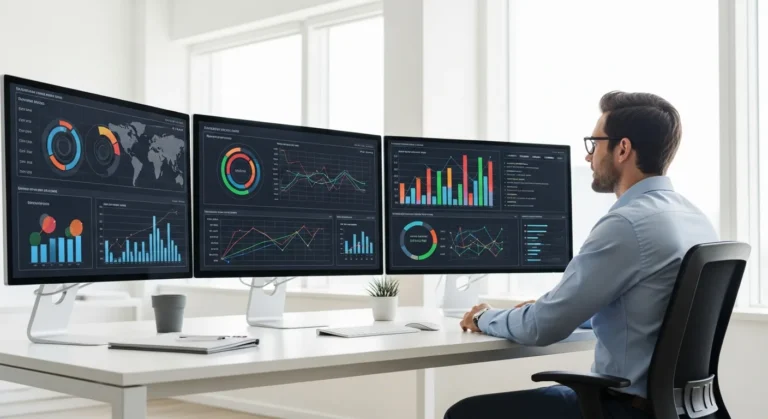
- Real-Time Data Visualization: A CEO needs to see his cash flow and inventory levels in a single, customized dashboard that updates instantly.
- AI-Driven Forecasting: Integrating machine learning allows a manager to predict demand spikes before they happen, based on his historical data.
- Mobile-First Architecture: His field team should be able to update project statuses directly from their tablets, ensuring the office stays in the loop without manual data entry.
- Seamless API Integrations: The ERP must talk to his existing CRM, shipping carriers, and banking portals without friction.
Navigating the Development Lifecycle
The journey to a custom ERP starts with a deep discovery phase. A technical architect will sit down with the business owner to map out every touchpoint of his operation. He shouldn’t just ask what the software should do, but what problems it needs to solve. This phase ensures that the final product isn’t just a digital version of a paper mess, but a refined, optimized engine.
Development usually happens in sprints. This allows the owner to see progress every few weeks and provide feedback. He can test modules—like the accounting or inventory sections—before the entire system is finished. This iterative approach reduces risk and ensures the final tool is exactly what he envisioned.
Calculating the Real ROI of Custom Systems
The upfront cost of custom ERP software is undeniably higher than a monthly subscription. However, a savvy CFO looks at the Total Cost of Ownership (TCO) over five years. When he factors in the lack of licensing fees, the reduction in manual labor through automation, and the increased accuracy of his data, the custom solution often pays for itself within the first 18 to 24 months.
Furthermore, the efficiency gains allow his team to focus on high-value tasks. Instead of a clerk spending his afternoon reconciling spreadsheets, he can focus on vendor negotiations or customer retention. The software becomes a force multiplier for his human talent.
Frequently Asked Questions
How long does it take to build a custom ERP?
Typically, a robust custom ERP takes between six months to a year to develop, depending on the complexity. A manager can often start using core modules much sooner through a phased rollout approach.
Is custom ERP software more secure than cloud-based SaaS?
It can be. Since the software isn’t a public-facing platform used by thousands of companies, it is a less likely target for mass exploits. An owner can also implement his own specific security protocols and hosting environments.
Can I integrate my old data into a new custom ERP?
Yes. Data migration is a standard part of the development process. A developer will write scripts to clean and move his historical data from old spreadsheets or legacy systems into the new database structure.
What happens if the developer leaves?
A professional development firm provides full documentation and source code ownership to the client. This ensures that the business owner can hire a new developer or internal team to maintain and update his system at any time.