
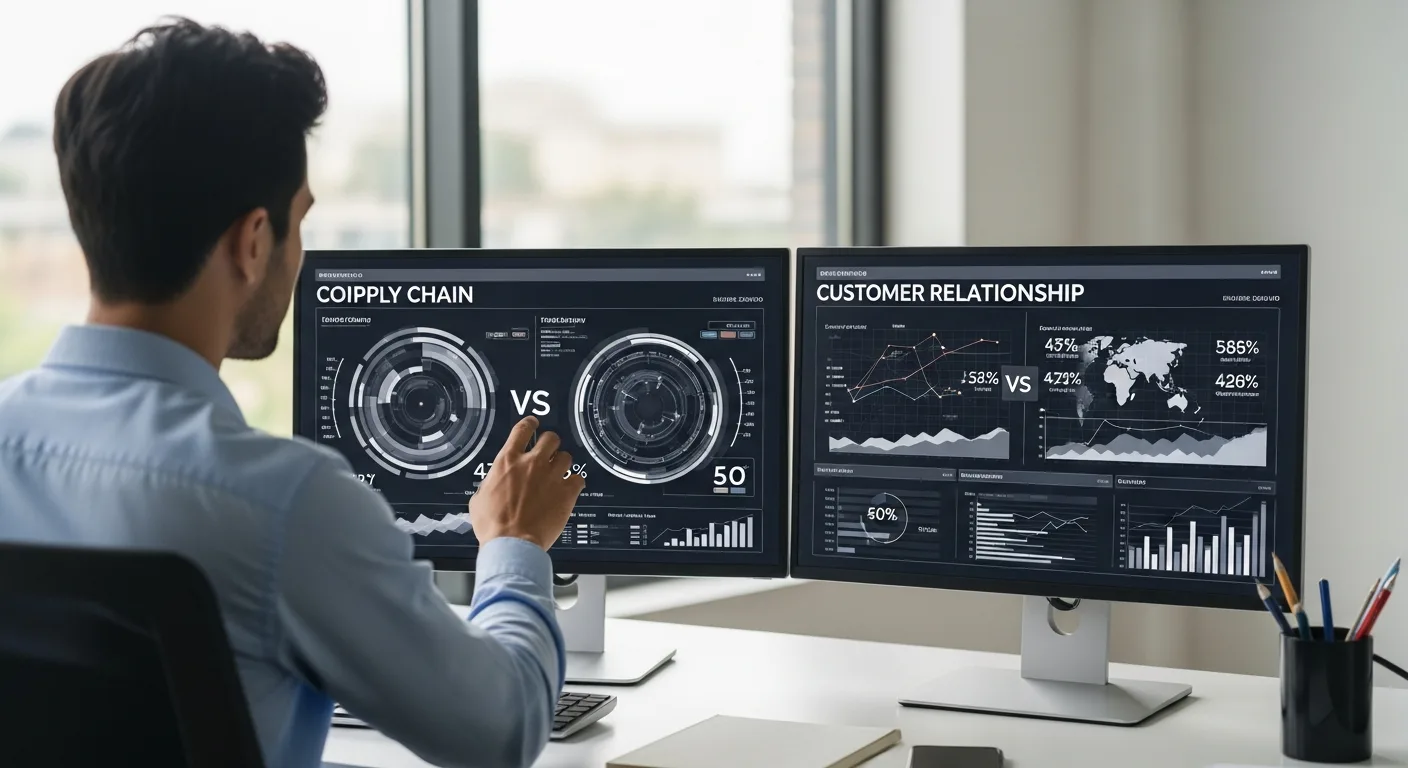
ERP System vs CRM: Which One Drives Your Business Growth?
The Fundamental Divide: Front Office vs. Back Office
Choosing between an ERP and a CRM isn’t about picking the ‘better’ software; it’s about identifying which part of the business needs a digital overhaul. A Customer Relationship Management (CRM) system is the heartbeat of the front office. It focuses on the customer, the sale, and the revenue. If a sales manager wants to track how many calls his team made yesterday, he looks at the CRM.
An Enterprise Resource Planning (ERP) system, conversely, is the backbone of the back office. It handles the heavy lifting of operations, finance, and supply chain management. When a production head needs to know if he has enough raw materials to fulfill an order, he turns to the ERP. While they often overlap, their core missions are distinct: one wins the customer, and the other ensures the business can actually deliver what was promised.
What is a CRM? (The Revenue Driver)
A CRM is designed to manage every interaction a business has with its clients and prospects. Its primary goal is to increase sales volume and improve customer retention. By centralizing data, it allows a salesman to see a lead’s entire history—emails, previous purchases, and support tickets—in one place.
- Sales Pipeline Management: Visualizing where every deal stands in the funnel.
- Marketing Automation: Sending targeted campaigns based on user behavior.
- Customer Support: Tracking issues to ensure no client feels ignored.
- Contact Management: Storing detailed profiles of every individual the business interacts with.
For a business owner, the CRM is his primary tool for forecasting growth. He uses it to identify which marketing channels are yielding the highest ROI and which sales reps are hitting their targets.
What is an ERP? (The Operational Engine)
An ERP system is much broader in scope. It integrates various departmental functions into a single database to streamline processes and information across the entire organization. It’s about efficiency, cost reduction, and data integrity.
Modern ERPs handle everything from accounting and payroll to inventory management and human resources. When a CFO wants to generate a consolidated financial report at the end of the quarter, he relies on the ERP to pull accurate data from every corner of the company. This level of visibility is why many leaders consider comprehensive management software for a growing enterprise to be a non-negotiable asset once they scale past a certain point.
Key Differences: ERP System vs CRM
The easiest way to distinguish the two is by looking at their primary users and objectives. A CRM is used by sales, marketing, and support teams. An ERP is used by accounting, warehouse staff, HR, and executives.
Focus: CRM focuses on the external (customer acquisition and satisfaction). ERP focuses on the internal (process optimization and resource allocation).
Financial Impact: A CRM aims to increase the top line (revenue). An ERP aims to improve the bottom line (profitability through cost control).
Complexity: ERP implementations are generally more complex and time-consuming because they touch almost every department. A CRM can often be rolled out to a sales team in a matter of weeks, whereas an ERP might take months of configuration.
Integration: The Best of Both Worlds
In a perfect world, these two systems don’t live in silos. When they are disconnected, you end up with data gaps. For example, a salesman might promise a customer a specific delivery date because his CRM shows the deal is closing, but he has no idea the ERP shows a massive delay in the supply chain.
By creating a unified data environment through a strategic integration of front and back-office tools, information flows seamlessly. When a deal is marked as ‘Closed-Won’ in the CRM, the ERP can automatically generate an invoice, update inventory levels, and notify the shipping department. This eliminates manual data entry and reduces the risk of human error.
Which One Should You Implement First?
The ‘which first’ question depends entirely on the current pain points of the business. If a company is struggling to find new customers or losing leads because of poor follow-up, a CRM is the priority. It provides the immediate boost in sales needed to fund further technology investments.
However, if the business is growing so fast that it can’t keep track of its finances, or if inventory is constantly missing, an ERP is the urgent fix. You cannot scale a business on broken processes. A manager must ensure his internal house is in order before he pours more fuel into the sales engine.
Frequently Asked Questions
Can an ERP replace a CRM?
Many modern ERP systems include a CRM module. While these modules might not be as feature-rich as a standalone CRM like Salesforce, they are often sufficient for businesses that want all their data in one single platform without managing multiple integrations.
Is a CRM cheaper than an ERP?
Generally, yes. CRM software is usually priced per user and requires less technical setup. ERP systems involve more modules, deeper customization, and significant data migration, making the total cost of ownership much higher.
Does a small business need both?
Not necessarily. Many small businesses start with a CRM to drive sales and use basic accounting software for finances. As the business grows and operations become more complex, they eventually migrate to a full ERP to consolidate their tech stack.